بخش I: Reading Comprehension درس ۱ کتاب کار زبان انگلیسی دهم
Simple ways to protect wildlife
One easy way to protect wildlife is learning about the endangered
animals that live around you. Teach your friends and family about the
wonderful birds, fish and plants that live near your home. In this way,
they are going to be more careful about nature. You can also visit a
national wildlife museum or park. These places give good information
about how to protect endangered animals and their homes. You can
do voluntary work in these places to help animals and their babies.
Another thing you can do is protecting the natural home of the
endangered animals. When you keep nature clean and safe, the animals
will live longer. Protecting the trees of forests is also helpful. If you
live in a village, you need to be very careful about the hunters who
come to your village to hurt animals. Whenever you see these people,
you need to call the police. These are simple things, but they will help
nature a lot.
پاسخ گام به گام و تشریحی بخش I: Reading Comprehension درس ۱ کتاب کار زبان انگلیسی دهم
این بخش شامل یک متن خواندنی دربارهٔ **راههای ساده برای محافظت از حیات وحش** ($\text{Simple ways to protect wildlife}$) است.
**ترجمه روان متن:**
یک راه آسان برای محافظت از حیات وحش، کسب اطلاعات دربارهٔ حیوانات در معرض خطر انقراض است که در اطراف شما زندگی میکنند. به دوستان و خانوادهٔ خود دربارهٔ پرندگان، ماهیها و گیاهان فوقالعادهای که نزدیک خانهٔ شما زندگی میکنند، آموزش دهید. به این ترتیب، آنها نسبت به طبیعت با دقتتر خواهند شد. شما همچنین میتوانید از یک موزه یا پارک ملی حیات وحش بازدید کنید. این مکانها اطلاعات خوبی دربارهٔ چگونگی محافظت از حیوانات در معرض خطر و خانههایشان میدهند. شما میتوانید در این مکانها کارهای داوطلبانه انجام دهید تا به حیوانات و بچههایشان کمک کنید. راهکار دیگری که میتوانید انجام دهید، محافظت از زیستگاه طبیعی حیوانات در معرض خطر انقراض است. وقتی طبیعت را تمیز و امن نگه میدارید، حیوانات بیشتر عمر خواهند کرد. محافظت از درختان جنگلها نیز مفید است. اگر در یک روستا زندگی میکنید، باید در مورد شکارچیانی که برای آسیب زدن به حیوانات به روستای شما میآیند، بسیار مراقب باشید. هر وقت این افراد را دیدید، باید به پلیس زنگ بزنید. اینها کارهای سادهای هستند، اما کمک زیادی به طبیعت خواهند کرد.
**نکات کلیدی و واژگان مهم:**
* $\text{wildlife}$: حیات وحش.
* $\text{endangered animals}$: حیوانات در معرض خطر انقراض.
* $\text{voluntary work}$: کار داوطلبانه.
* $\text{natural home}$: زیستگاه طبیعی.
* $\text{hunters}$: شکارچیان.
* $\text{call the police}$: به پلیس زنگ زدن.
***
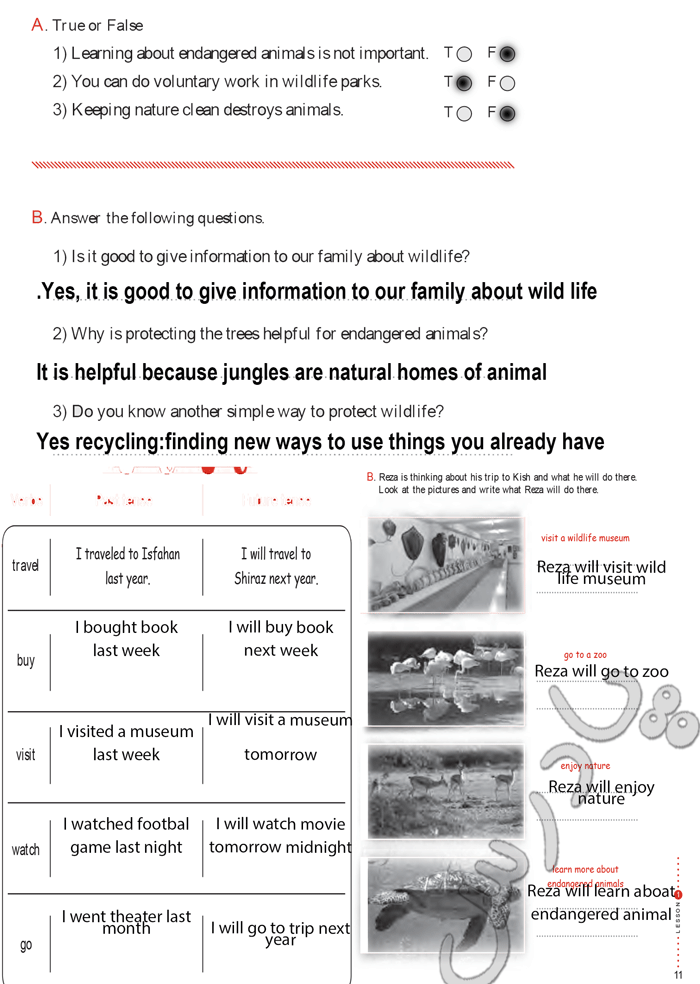
## A. True or False
1) $\text{Learning about endangered animals is not important.}$ $\text{T}quare ext{F}quare$
* **بررسی متن:** $\text{One easy way to protect wildlife is learning about the endangered animals...}$ (یک راه آسان محافظت از حیات وحش، یادگیری دربارهٔ حیوانات در معرض خطر است.) $\rightarrow$ یادگیری مهم است.
* **پاسخ صحیح:** $\text{F}$ (False)
2) $\text{You can do voluntary work in wildlife parks.}$ $\text{T}quare ext{F}quare$
* **بررسی متن:** $\text{You can do voluntary work in these places to help animals...}$ (میتوانید در این مکانها کار داوطلبانه انجام دهید.)
* **پاسخ صحیح:** $\text{T}$ (True)
3) $\text{Keeping nature clean hurts animals.}$ $\text{T}quare ext{F}quare$
* **بررسی متن:** $\text{When you keep nature clean and safe, the animals will live longer.}$ (وقتی طبیعت را تمیز و امن نگه دارید، حیوانات بیشتر عمر میکنند.) $\rightarrow$ تمیز نگه داشتن به حیوانات کمک میکند.
* **پاسخ صحیح:** $\text{F}$ (False)
***
## B. Answer the following questions.
1) $\text{Is it good to give information to our family about wildlife}?$
* **پاسخ:** $\text{Yes, it is. In this way, they are going to be more careful about nature.}$ (بله، خوب است. به این ترتیب، آنها نسبت به طبیعت محتاطتر خواهند بود.)
2) $\text{Why is protecting the trees helpful for endangered animals}?$
* **پاسخ:** $\text{Protecting the trees of forests is helpful because it is the natural home of the endangered animals.}$ (محافظت از درختان جنگلها مفید است زیرا خانهٔ طبیعی حیوانات در معرض خطر است.)
3) $\text{Do you know another simple way to protect wildlife}?$
* **پاسخ (پیشنهادی - بر اساس متن درس):** $\text{Yes, I do. We should call the police whenever we see hunters who come to hurt animals.}$ (بله. ما باید هر وقت شکارچیانی را که برای آسیب زدن به حیوانات میآیند، میبینیم، با پلیس تماس بگیریم.)
*(همچنین میتوان پاسخهایی مانند: $\text{We should avoid buying products that use endangered animals.}$ (ما باید از خرید محصولاتی که از حیوانات در معرض خطر استفاده میکنند، خودداری کنیم.) را ارائه داد.)*
بخش II: Grammar A درس ۱ کتاب کار زبان انگلیسی دهم
A. Complete the chart. Write the things you did in the past and you will
do in the future.
Verbs | Past tense | Future tense
---|---|---
travel | I traveled to Isfahan last year. | I will travel to Shiraz next year.
buy | |
visit | |
watch | |
go | |
پاسخ گام به گام و تشریحی بخش II: Grammar A درس ۱ کتاب کار زبان انگلیسی دهم
این تمرین بر روی ساخت جملات در زمان **گذشته ساده** ($\text{Simple Past}$) و **آینده ساده** ($\text{Simple Future}$ با $\text{will}$) تمرکز دارد.
**قوانین:**
1. **گذشته ساده:** $\text{Subject} + \text{Past Verb (ed / irregular)} + \text{Past Time Indicator}$ ($\text{yesterday, last year}$).
2. **آینده ساده ($\text{will}$):** $\text{Subject} + \text{will} + \text{Base Form of Verb} + \text{Future Time Indicator}$ ($\text{next week, tomorrow}$).
| $\text{Verbs}$ | $\text{Past Tense (گذشته ساده)}$ | $\text{Future Tense (آینده ساده)}$ |
| :--- | :--- | :--- |
| $\text{travel}$ | $\text{I traveled to Isfahan last year.}$ | $\text{I will travel to Shiraz next year.}$ |
| $\text{buy}$ (بیقاعده) | $\text{I bought a new book yesterday.}$ | $\text{I will buy a mobile phone next month.}$ |
| $\text{visit}$ (باقاعده) | $\text{We visited our relatives last Friday.}$ | $\text{We will visit the museum tomorrow.}$ |
| $\text{watch}$ (باقاعده) | $\text{She watched a film last night.}$ | $\text{She will watch a documentary next week.}$ |
| $\text{go}$ (بیقاعده) | $\text{He went to the zoo two days ago.}$ | $\text{He will go to the park this afternoon.}$ |
بخش II: Grammar B درس ۱ کتاب کار زبان انگلیسی دهم
B. Reza is thinking about his trip to Kish and what he will do there.
Look at the pictures and write what Reza will do there.
visit a wildlife museum
go to a zoo
enjoy nature
learn more about
endangered animals
پاسخ گام به گام و تشریحی بخش II: Grammar B درس ۱ کتاب کار زبان انگلیسی دهم
این تمرین بر روی ساخت جملات در زمان **آینده ساده** ($\text{Simple Future}$ با $\text{will}$) برای بیان برنامهها و پیشبینیهای سفر $\text{Reza}$ به کیش تمرکز دارد. باید عبارات را با تصاویر مرتبط و سپس با ساختار $\text{Reza will + Base Verb}$ جملهسازی کنیم.
**قانون:** برای صحبت دربارهٔ برنامههای آینده (بدون قطعیت صددرصدی)، از $\text{will}$ استفاده میشود.
**جملات پیشنهادی (بر اساس تصاویر):**
1. **(تصویر موزه حیات وحش):** $\text{Reza will}$ **visit a wildlife museum** $\text{in Kish.}$
2. **(تصویر فلامینگوها / حیوانات در طبیعت):** $\text{Reza will}$ **enjoy nature** $\text{there.}$
3. **(تصویر غزالها / حیوانات):** $\text{Reza will}$ **learn more about endangered animals** $\text{on his trip.}$
4. **(تصویر لاکپشت دریایی / حیوانات آبزی):** $\text{Reza will}$ **go to a zoo** $\text{or aquarium to see sea animals.}$ (با توجه به وجود لاکپشت و عدم وجود تصویر باغ وحش، میتوان از $\text{go to a zoo}$ یا $\text{see sea animals}$ استفاده کرد.)
بخش II: Grammar C درس ۱ کتاب کار زبان انگلیسی دهم
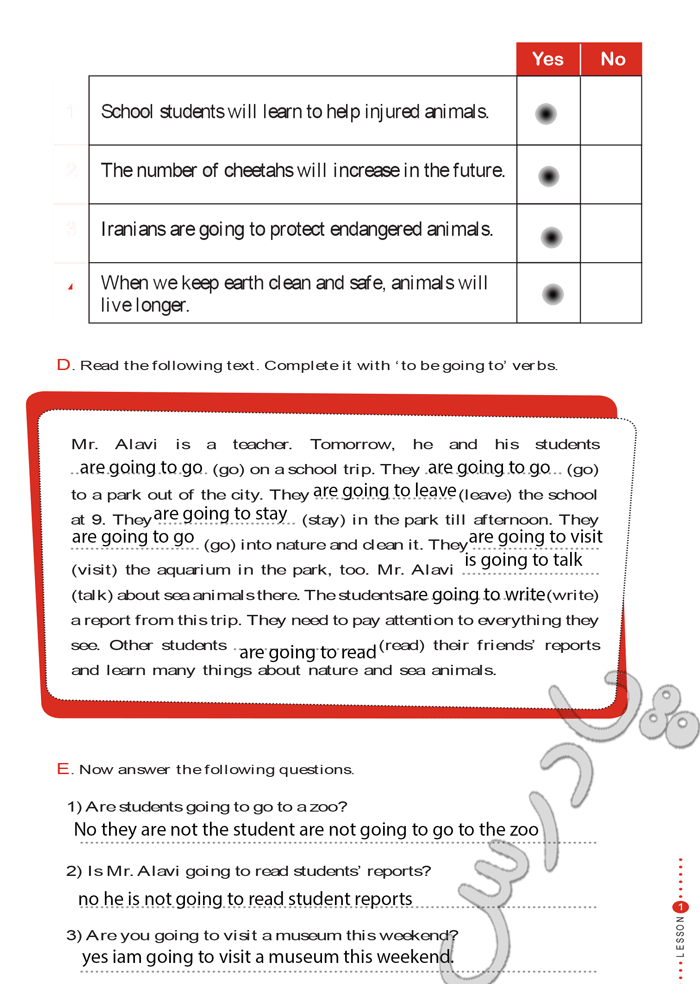
C. Yes or No ?
Yes No
1 School students will learn to help injured animals.
2 The number of cheetahs will increase in the future.
3 Iranians are going to protect endangered animals.
4 When we keep earth clean and safe, animals will live longer.
پاسخ گام به گام و تشریحی بخش II: Grammar C درس ۱ کتاب کار زبان انگلیسی دهم
این تمرین بر روی درک جملات در زمان **آینده** ($\text{will}$ و $\text{be going to}$) و **حال ساده** و سنجش آنها با حقایق درس و موضوع حفاظت از محیط زیست تمرکز دارد.
1. **$\text{School students will learn to help injured animals.}$** (دانشآموزان یاد خواهند گرفت به حیوانات آسیب دیده کمک کنند.)
* **تحلیل:** این یک پیشبینی منطقی و مثبت مرتبط با اهداف درس است.
* **پاسخ صحیح:** $\text{Yes}$
2. **$\text{The number of cheetahs will increase in the future.}$** (تعداد یوزپلنگها در آینده افزایش خواهد یافت.)
* **تحلیل:** این یک امید و پیشبینی مثبت در راستای حفاظت است.
* **پاسخ صحیح:** $\text{Yes}$
3. **$\text{Iranians are going to protect endangered animals.}$** (ایرانیها قصد دارند از حیوانات در معرض خطر محافظت کنند.)
* **تحلیل:** این یک برنامهٔ مثبت و بیان قصد عمومی است.
* **پاسخ صحیح:** $\text{Yes}$
4. **$\text{When we keep earth clean and safe, animals will live longer.}$** (وقتی زمین را تمیز و امن نگه داریم، حیوانات بیشتر عمر خواهند کرد.)
* **تحلیل:** این یک حقیقت کلی مرتبط با حفظ محیط زیست است و در متن $\text{Part I}$ هم ذکر شد: $\text{When you keep nature clean and safe, the animals will live longer.}$
* **پاسخ صحیح:** $\text{Yes}$
بخش II: Grammar D و E درس ۱ کتاب کار زبان انگلیسی دهم
D. Read the following text. Complete it with 'to be going to' verbs.
Mr. Alavi is a teacher. Tomorrow,
he and his
students (go) on a school trip. They (go)
to a park out of the city. They (leave) the school
at 9. They (stay) in the park till afternoon. They
(go) into nature and clean it. They (visit) the aquarium in the park, too. Mr. Alavi (talk) about sea animals there. The students (write)
a report from this trip. They need to pay attention to everything they
see. Other students (read) their friends' reports
and learn many things about nature and sea animals.
E. Now answer the following questions.
1) Are the students going to go to a zoo?
2) Is Mr. Alavi going to read the students' reports?
3) Are you going to visit a museum this weekend?
پاسخ گام به گام و تشریحی بخش II: Grammar D و E درس ۱ کتاب کار زبان انگلیسی دهم
این تمرین بر روی استفاده از زمان **آینده نزدیک** ($\text{Near Future}$) با ساختار $\text{be going to}$ برای بیان برنامهها و مقاصد قطعی در آینده تمرکز دارد.
**قانون $\text{be going to}$:** $\text{Subject} + \text{am / is / are} + \text{going to} + \text{Base Form of Verb}$.
## D. تکمیل متن
$\text{Mr. Alavi is a teacher. Tomorrow, he and his students}$ **are going to go** $\text{on a school trip. They}$ **are going to go** $\text{to a park out of the city. They}$ **are going to leave** $\text{the school at 9. They}$ **are going to stay** $\text{in the park till afternoon. They}$ **are going to go** $\text{into nature and clean it. They}$ **are going to visit** $\text{the aquarium in the park, too. Mr. Alavi}$ **is going to talk** $\text{about sea animals there. The students}$ **are going to write** $\text{a report from this trip. They need to pay attention to everything they see. Other students}$ **are going to read** $\text{their friends' reports and learn many things about nature and sea animals.}$
* **نکته:** برای $\text{he and his students}$ (جمع) از $\text{are}$ استفاده میشود. برای $\text{Mr. Alavi}$ (مفرد) از $\text{is}$ استفاده میشود.
***
## E. پاسخ به سؤالات
1) $\text{Are the students going to go to a zoo}?$
* **بررسی متن:** آنها قرار است از **آکواریوم** ($\text{aquarium}$) در پارک بازدید کنند، نه باغ وحش ($\text{zoo}$).
* **پاسخ:** $\text{No, they aren't. They are going to visit the aquarium in the park.}$
2) $\text{Is Mr. Alavi going to read the students' reports}?$
* **بررسی متن:** $\text{The students are going to write a report}$ و $\text{Other students are going to read their friends' reports}$. اشارهای به خواندن گزارشها توسط آقای علوی نشده است.
* **پاسخ:** $\text{No, he isn't. The students are going to read their friends' reports.}$
3) $\text{Are you going to visit a museum this weekend}?$
* **پاسخ (شخصی/پیشنهادی):** $\text{Yes, I am. I'm going to visit a national museum. / No, I'm not. I'm going to go to the park with my family.}$
بخش III: Vocabulary C و D درس ۱ کتاب کار زبان انگلیسی دهم
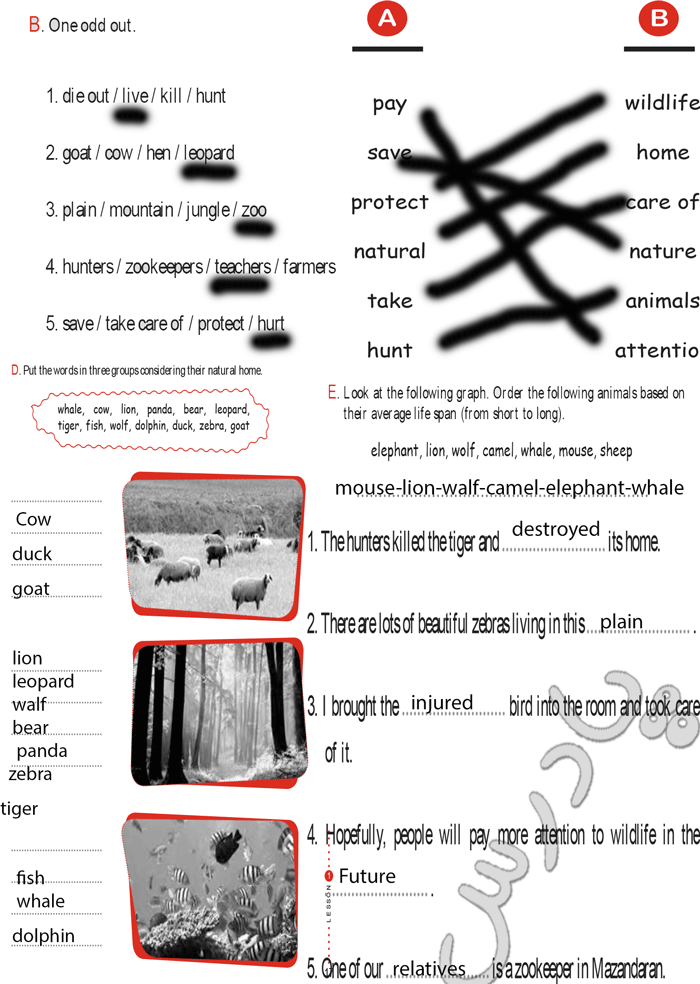
C. Match columns A and B.
A | B
---|---
pay | wildlife
save | home
care of | protect
protect | natural
natural | nature
take | animals
hunt | attention
D. Put the words in three groups considering their natural home.
whale, cow, lion, panda, bear,
leopard,
tiger, fish, wolf, dolphin, duck, zebra, goat
پاسخ گام به گام و تشریحی بخش III: Vocabulary C و D درس ۱ کتاب کار زبان انگلیسی دهم
این تمرین بر روی تکمیل **افعال عبارتی** ($\text{Phrasal Verbs}$) و دستهبندی حیوانات بر اساس **زیستگاه طبیعی** آنها تمرکز دارد.
## C. تطبیق ستونها
این تطبیقها بر اساس عبارات ترکیبی رایج در انگلیسی و واژگان درس انجام میشود:
1. $\text{pay} \rightarrow$ **$\text{attention}$** ($\text{pay attention}$: توجه کردن)
2. $\text{save} \rightarrow$ **$\text{animals}$** ($\text{save animals}$: حیوانات را نجات دادن)
3. $\text{protect} \rightarrow$ **$\text{wildlife}$** ($\text{protect wildlife}$: از حیات وحش محافظت کردن)
4. $\text{natural} \rightarrow$ **$\text{home}$** ($\text{natural home}$: زیستگاه طبیعی)
5. $\text{take} \rightarrow$ **$\text{care of}$** ($\text{take care of}$: مراقبت کردن)
6. $\text{hunt} \rightarrow$ **$\text{animals}$** (شکار حیوانات)
*(توجه: $\text{protect}$ و $\text{save}$ هر دو میتوانند با $\text{animals}$ و $\text{wildlife}$ جفت شوند، اما $\text{protect wildlife}$ و $\text{save animals}$ ترکیبهای رایج در درس هستند.)*
| $\text{A}$ | $\text{B}$ |
| :--- | :--- |
| $\text{pay}$ | $\text{attention}$ |
| $\text{save}$ | $\text{animals}$ |
| $\text{protect}$ | $\text{wildlife}$ |
| $\text{natural}$ | $\text{home}$ |
| $\text{take}$ | $\text{care of}$ |
| $\text{hunt}$ | $\text{animals}$ |
***
## D. دستهبندی حیوانات بر اساس زیستگاه طبیعی
سه گروه زیستگاه اصلی (آب، مزرعه، خشکی/جنگل) وجود دارند.
| $\text{Water Animals}$ (آبزیان) | $\text{Farm / Domestic Animals}$ (اهلی/مزرعهای) | $\text{Wild Animals (Land)}$ (حیوانات وحشی/خشکی) |
| :--- | :--- | :--- |
| $\text{whale}$ (وال) | $\text{cow}$ (گاو) | $\text{lion}$ (شیر) |
| $\text{fish}$ (ماهی) | $\text{goat}$ (بز) | $\text{panda}$ (پاندا) |
| $\text{dolphin}$ (دلفین) | | $\text{bear}$ (خرس) |
| $\text{duck}$ (اردک - میتواند در هر دو باشد، اما معمولاً آبزی) | | $\text{leopard}$ (پلنگ) |
| | | $\text{tiger}$ (ببر) |
| | | $\text{wolf}$ (گرگ) |
| | | $\text{zebra}$ (گورخر) |
بخش III: Vocabulary E درس ۱ کتاب کار زبان انگلیسی دهم
E. Look at the following graph. Order the following animals based on
their average life span (from short to long).
elephant, lion, wolf, camel, whale, mouse, sheep
پاسخ گام به گام و تشریحی بخش III: Vocabulary E درس ۱ کتاب کار زبان انگلیسی دهم
این تمرین بر روی استفاده از نمودار برای مقایسهٔ **طول عمر متوسط** ($\text{average life span}$) حیوانات و مرتبسازی آنها از **کوتاهترین** به **طولانیترین** طول عمر تمرکز دارد.
**بررسی نمودار (تخمین طول عمر):**
* $\text{mouse}$: حدود $\text{1}$ تا $\text{3}$ سال (اولین حیوان در مسیر)
* $\text{sheep}$ (گوسفند): حدود $\text{12}$ سال (ردیف گوسفند)
* $\text{wolf}$ (گرگ): حدود $\text{15}$ تا $\text{20}$ سال (ردیف گرگ)
* $\text{lion}$ (شیر): حدود $\text{20}$ سال (ردیف شیر)
* $\text{camel}$ (شتر): حدود $\text{30}$ سال (ردیف شتر)
* $\text{elephant}$ (فیل): حدود $\text{60}$ سال (ردیف فیل)
* $\text{whale}$ (وال): حدود $\text{90}$ تا $\text{100}$ سال (ردیف وال)
**ترتیب صحیح (از کوتاه به بلند):**
1. **$\text{Mouse}$** (کوتاهترین)
2. **$\text{Sheep}$**
3. **$\text{Wolf}$**
4. **$\text{Lion}$**
5. **$\text{Camel}$**
6. **$\text{Elephant}$**
7. **$\text{Whale}$** (طولانیترین)
بخش V: Writing A درس ۱ کتاب کار زبان انگلیسی دهم
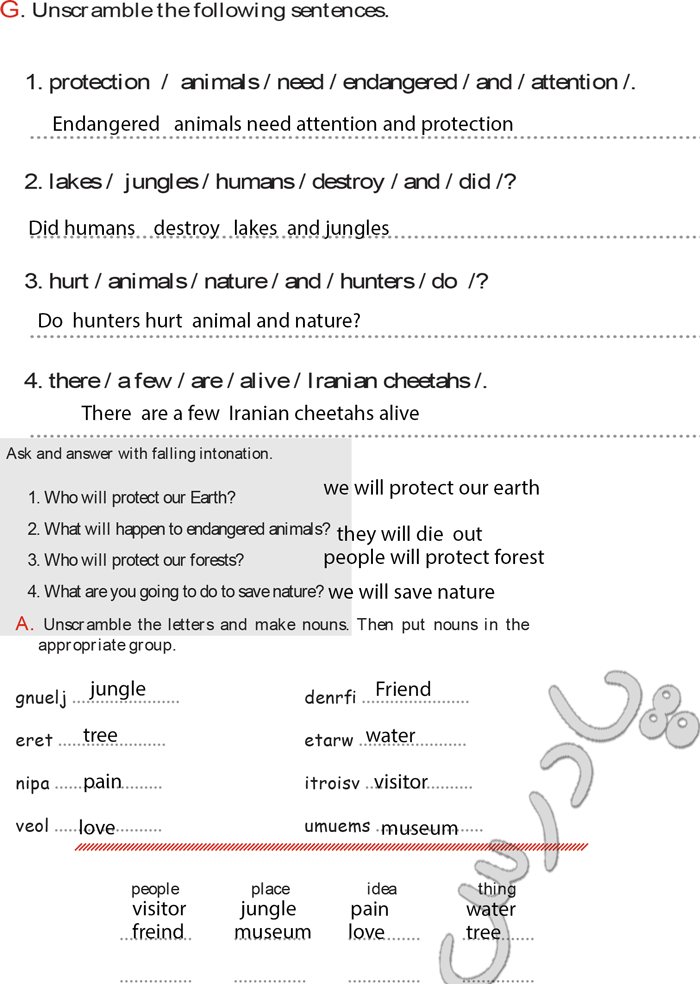
A. Unscramble the letters and make nouns. Then put nouns in the
appropriate group.
gnuelj
eret
nipa
veol
denrfi
etarw
itroisv
umuems
people
place
idea
thing
پاسخ گام به گام و تشریحی بخش V: Writing A درس ۱ کتاب کار زبان انگلیسی دهم
این تمرین بر روی مرتبسازی حروف بههمریخته برای ساختن **اسم** ($\text{Noun}$) و سپس **دستهبندی** آنها در گروههای مناسب تمرکز دارد.
## ۱. ساختن اسمها ($\text{Unscrambling}$)
1. $\text{gnuelj} \rightarrow$ **$\text{JUNGLE}$** (جنگل)
2. $\text{eret} \rightarrow$ **$\text{TREE}$** (درخت)
3. $\text{nipa} \rightarrow$ **$\text{PLAIN}$** (دشت)
4. $\text{veol} \rightarrow$ **$\text{LOVE}$** (عشق)
5. $\text{denrfi} \rightarrow$ **$\text{FRIEND}$** (دوست)
6. $\text{etarw} \rightarrow$ **$\text{WATER}$** (آب)
7. $\text{itroisv} \rightarrow$ **$\text{VISITOR}$** (بازدیدکننده)
8. $\text{umuems} \rightarrow$ **$\text{MUSEUM}$** (موزه)
## ۲. دستهبندی اسمها ($\text{Categorization}$)
| $\text{people}$ (افراد) | $\text{place}$ (مکان) | $\text{idea}$ (مفهوم) | $\text{thing}$ (شیء/غیرمکان) |
| :--- | :--- | :--- | :--- |
| $\text{FRIEND}$ (دوست) | $\text{JUNGLE}$ (جنگل) | $\text{LOVE}$ (عشق/دوست داشتن) | $\text{TREE}$ (درخت) |
| $\text{VISITOR}$ (بازدیدکننده) | $\text{PLAIN}$ (دشت) | | $\text{WATER}$ (آب) |
| | $\text{MUSEUM}$ (موزه) | | |
بخش V: Writing B درس ۱ کتاب کار زبان انگلیسی دهم
B. Read the text in Part I.
1. Find all singular nouns. Change them into plural.
2. Find all plural nouns. Change them into singular.
پاسخ گام به گام و تشریحی بخش V: Writing B درس ۱ کتاب کار زبان انگلیسی دهم
این تمرین بر روی شناسایی **اسمهای مفرد** ($\text{Singular Nouns}$) و **اسمهای جمع** ($\text{Plural Nouns}$) در متن $\text{Part I}$ و تبدیل آنها به شکل مقابل تمرکز دارد.
**متن $\text{Part I}$:** $\text{Simple ways to protect wildlife. One easy way to protect wildlife is learning about the endangered animals that live around you. Teach your friends and family about the wonderful birds, fish and plants that live near your home. In this way, they are going to be more careful about nature. You can also visit a national wildlife museum or park. These places give good information about how to protect endangered animals and their homes. You can do voluntary work in these places to help animals and their babies. Another thing you can do is protecting the natural home of the endangered animals. When you keep nature clean and safe, the animals will live longer. Protecting the trees of forests is also helpful. If you live in a village, you need to be very careful about the hunters who come to your village to hurt animals. Whenever you see these people, you need to call the police. These are simple things, but they will help nature a lot.}$
## ۱. اسمهای مفرد و تبدیل آنها به جمع
| $\text{Singular Noun (مفرد)}$ | $\text{Plural Noun (جمع)}$ |
| :--- | :--- |
| $\text{way}$ | $\text{ways}$ |
| $\text{fish}$ | $\text{fish}$ (شکل مفرد و جمع یکسان است) |
| $\text{home}$ | $\text{homes}$ |
| $\text{nature}$ | $\text{natures}$ |
| $\text{museum}$ | $\text{museums}$ |
| $\text{park}$ | $\text{parks}$ |
| $\text{thing}$ | $\text{things}$ |
| $\text{village}$ | $\text{villages}$ |
| $\text{police}$ | $\text{police}$ (شکل مفرد و جمع یکسان است) |
## ۲. اسمهای جمع و تبدیل آنها به مفرد
| $\text{Plural Noun (جمع)}$ | $\text{Singular Noun (مفرد)}$ |
| :--- | :--- |
| $\text{animals}$ | $\text{animal}$ |
| $\text{friends}$ | $\text{friend}$ |
| $\text{plants}$ | $\text{plant}$ |
| $\text{places}$ | $\text{place}$ |
| $\text{babies}$ | $\text{baby}$ |
| $\text{trees}$ | $\text{tree}$ |
| $\text{forests}$ | $\text{forest}$ |
| $\text{hunters}$ | $\text{hunter}$ |
| $\text{people}$ | $\text{person}$ (یا $\text{man/woman}$) |